
The Short Stack
A simple, four-layer operating rhythm that holds transformation teams together.
There is no shortage of advice on how to run a productive team. Frameworks, methodologies, certifications. And yet, most teams still feel like they are sprinting on a treadmill: busy, and genuinely unsure if they are winning.
Structure, not effort, is the limiting factor.
This is especially true for transformation teams — the ones building something new, navigating ambiguity, and operating without a clear playbook. These teams don't lack commitment. They lack rhythm. And without rhythm, even the most talented group will default to the one thing that feels productive but rarely is: more meetings.
The Short Stack is a four-layer operating rhythm for transformation teams. Each layer is distinct. Each has a specific job. Together, they hold the team.
Why Most Team Systems Fall Apart
Most teams don't design their operating rhythm. They accumulate it.
A standup meeting gets added here. A steering group spun up there. A weekly sync that nobody quite remembers the purpose of. Before long, the calendar is full and the team is exhausted, but alignment remains elusive.
This is additive bias at work — see The "Add More" Trap. Teams add new rituals without ever removing the ones that stopped working. The result is layers without intention: a team operating system that grew slowly, organically, and completely unplanned.
When you are building something new, or transforming something that already exists, this is fatal. Ambiguity is already working against you. The last thing you need is a meeting structure that adds noise instead of cutting through it.
Introducing the Stack
Think of your team's operating rhythm as a short stack. Four layers. Each one intentional. Each one reinforcing the next.
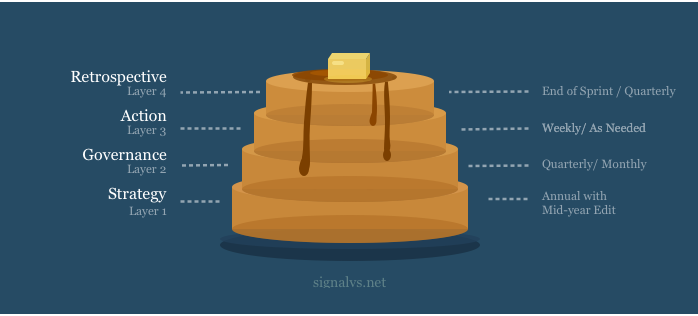
No layer works in isolation. Strategy without governance stalls. Governance without action-oriented meetings loses touch with reality. Action without reflection just accelerates in the wrong direction. The layers are designed to work together.
Layer 1: Strategy
Where are we going, and why?
Strategy is the foundation. Everything else in the stack points back to it.
For transformation teams, this layer is especially fragile. Strategy in ambiguous environments is not static. It shifts. It gets pressure-tested. It sometimes gets scrapped entirely. That's not failure; that's the work.
The job of this layer is not to produce a polished slide deck that lives in a shared drive. It is to give the team a clear filter for priorities — something sharp enough that every person on the team can articulate it in a sentence, and concrete enough to guide choices when priorities compete.
Strategy is too often treated as something that happens to a team rather than with one. A group of executives convenes, a direction is set, and the output cascades downward — polished, confident, and frequently disconnected from reality.
That's a mistake. The people closest to the work are not just executors. They are your best quality control. They will find the gaps in your logic, surface the assumptions you didn't know you were making, and highlight the dependencies leadership couldn't see from above. That feedback doesn't undermine the vision. It sharpens it.
Leadership should set the direction — the why, the general direction of travel. But that goal needs to survive contact with the people tasked with achieving it. Build in the feedback loops. Create the conditions — deliberately facilitated sessions, with proper pre-work (not a blank whiteboard and good intentions) — where the team can push back, pressure-test, and occasionally redirect.
A goal that can't withstand scrutiny from your own team won't survive contact with reality either.
Set the strategy once a year. Edit it at the midyear point in a retrospective. More on that in Layer 4.
Layer 2: Governance & Decision Making
Who decides what — and how fast?
This is the most under-designed layer in almost every team I have encountered. And it is the one that causes the most pain.
Slow decisions are not a people problem. They are a structure one. When decision rights are unclear, everything defaults upward — to the most senior person in the room or to an executive. The result is bottlenecks dressed up as due diligence.
For transformation teams, this is particularly acute. You are making consequential calls in conditions of uncertainty, often without precedent to lean on. The teams that move well are not necessarily smarter. They are clearer on the micro decisions they are willing to make and learn from. They know who owns what. They know when to escalate and when to just decide.
Good governance is not bureaucracy. The opposite: it is what makes speed possible. You just have to take the time to design it.
Layer 3: Action & Work in Progress Meetings
Are we moving? Are we unblocked?
This is the layer most teams accumulate without design. That under-investment leads over time to a mashup: 1-1s, stand-up meetings, scrums, weekly syncs all piled on top of each other, all doing similar things but not quite the same.
The two most underrated tools in a team leader's arsenal are not frameworks or methodologies. They are the 1-1 and the Work in Progress meeting.
The 1-1. Done well, it is where blockers get surfaced before they become problems, where context gets shared before it becomes confusion, and where the individual gets the attention they need to keep moving. Done poorly, it's a status update.
A good 1-1 is led by the team member, not the leader. It is forward-looking — always highlighting what is in the way, what is needed, and what comes next. Not a recap of what already happened. Keep them regular, keep them short, and resist the temptation to fill the time. Silence in a 1-1 is usually something worth digging into.
The Work in Progress (WIP) meeting. This is where individual momentum becomes collective momentum. Its job is simple: keep work moving across the team. Surface what is stuck, clarify what is unclear, unblock work, and get out.
The trap most teams fall into is letting these meetings drift into status theatre — a round-the-room recital of updates that nobody needed to hear out loud. Or they give in to the temptation to use the time to think out loud. Resist it. Thinking out loud has its place. It is just not here.
If someone leaves your WIP meeting unclear on what they are doing next, the meeting failed — regardless of how long it ran or how many people attended. Keep these meetings short (45 minutes maximum). Keep them action-oriented. And kill them the moment they stop doing their job.
Layer 4: Retrospectives
Are we learning — or just repeating?
The layer most teams skip. And yet it is the layer that can bring calm to the chaos of transformation work.
Retrospectives have a reputation problem. They are often treated as a formality — a box to check at the end of a quarter or OKR cycle before everyone moves on to the next one. Done poorly, they're a venting session. Done well, they are one of the most powerful tools a team has.
For transformation teams, learning is the work. You are, by definition, operating without a complete map of what lies ahead. Every iteration is data. Every missed KR is a signal. The teams that change how they work — not just what they are working on — are the ones that build something that lasts.
Treat retrospectives like a competitive advantage. Because they are.
The Syrup Test ...
To make sure your layers are sufficiently connected, run this quick gut check:
- Can everyone on your team name the top strategic priority right now? [Layer 1: Strategy]
- Was the last decision your team made slowed down by unclear ownership? [Layer 2: Governance]
- How many blockers from last week's meeting are still open this week? [Layer 3: WIPs & Action]
- Name one thing your team is doing differently today because of a retrospective. [Layer 4: Retrospective]
If any of those land uncomfortably, you know it's time to stop and change how your team works.
Structure beats hustle. Build your stack.